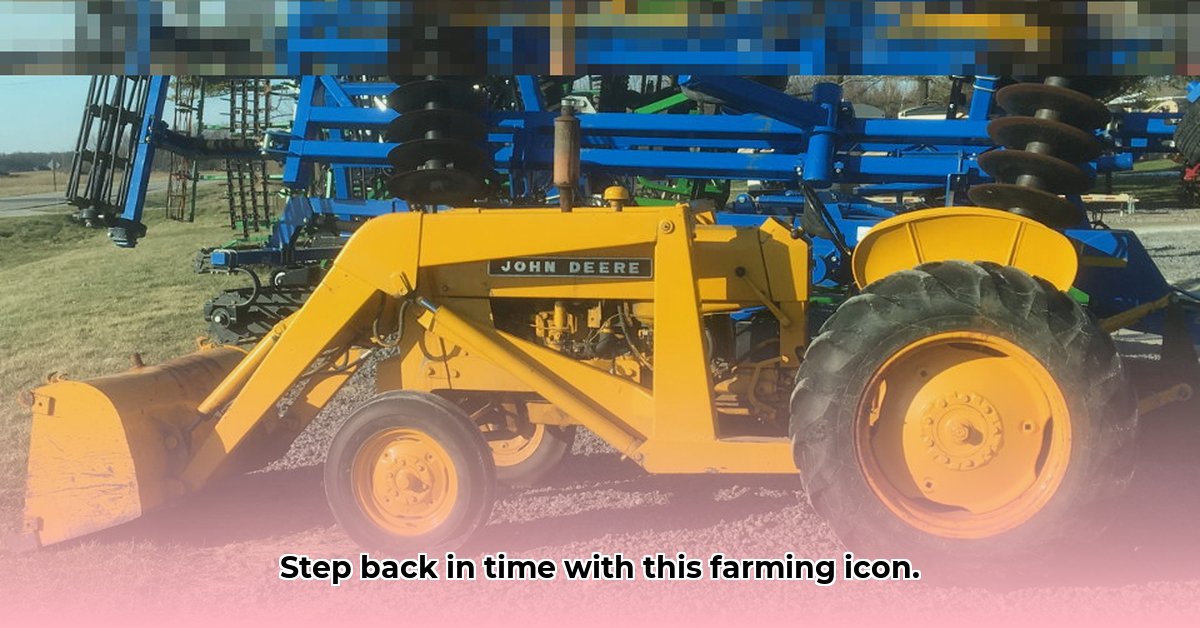
The John Deere 440 tractor, a prominent workhorse of the 1950s and 1960s, significantly impacted agricultural mechanization. This article examines its design, operational characteristics, and—crucially—its nuanced relationship with sustainability. While its technological advancements are undeniable, a complete assessment of its environmental impact is hampered by a lack of comprehensive historical data. For more on vintage tractor history, see this helpful site.
Engine Power and Fuel Efficiency
The JD 440 series encompassed a range of models, initially featuring smaller, two-cylinder engines (1.7-1.9 liters) powered by either gasoline or diesel fuel. Later iterations incorporated more powerful four-cylinder engines (3.0 and 3.3 liters). This increase in engine displacement likely improved power output and, potentially, fuel efficiency. However, precise fuel consumption figures from this era remain elusive, hindering a definitive assessment. This data scarcity highlights a broader challenge in evaluating the overall environmental performance of the JD 440. How much more fuel efficient were these larger engines in reality? That question remains unanswered due to the lack of available data.
Adaptability and Versatility
A key feature of the JD 440 was its adaptability. The available configurations included two-wheel drive models for level fields, four-wheel drive versions for challenging terrain, and tracked crawler variants ideal for muddy conditions. This versatility expanded the tractor's applicability across diverse farming operations and geographical locations, demonstrating a growing recognition of the need for adaptable machinery in agriculture. This adaptability, however, also contributed to its widespread use and therefore potentially amplified any environmental consequences.
The Sustainability Question: Data Gaps and Limitations
While the technological innovations of the JD 440 are readily apparent, evaluating its long-term environmental consequences presents a significant challenge, primarily due to the absence of comprehensive data. Information on greenhouse gas emissions during operation, overall fuel consumption, and manufacturing/disposal processes is largely lacking. This lack of historical data prevents a definitive assessment of its sustainability. Consequently, any assertion of the JD 440's overall environmental impact must acknowledge this crucial limitation.
Industrial and Skidder Variants: A Comparison
The differences between the industrial JD 440 and its skidder variant further illustrate the tractor's versatility. The skidder, designed for tasks such as forestry and land clearing, boasted a significantly larger engine (44.0 kW vs. 19.9 kW for the industrial model). This highlights the evolving applications of the underlying technology and the tractor's capacity to serve demanding roles beyond traditional agriculture. Were these higher power outputs offset by proportionally higher fuel consumption? This question cannot be answered from available data.
The JD 440's Enduring Legacy: A Call for Further Research
The JD 440's legacy extends beyond its immediate technological contributions. It serves as a case study in the evaluation of past agricultural machinery and the challenges of determining long-term environmental impacts. Further research is necessary to fully understand its impact on the environment. A collaborative effort is needed to uncover and analyze relevant historical records and assess the tractor's full lifecycle effect on the environment.
Assessing the Environmental Impact: A Methodological Framework
To better understand the ecological impact of the JD 440, a multi-faceted approach is required:
Fuel Efficiency Analysis: Compare the JD 440's fuel consumption per hour to contemporary and modern tractors of similar power output. Higher fuel consumption directly translates to increased emissions.
Emission Profile: While specific emission data are scarce, analysis of similar engines from that era can help estimate pollutant levels (e.g., CO2, NOx, particulate matter). Comparison with modern emission standards can highlight the differences.
Operational Practices: How the 440 was used significantly impacted its environmental effect. Intensive tillage practices common at that time exacerbated soil compaction. The extent of soil disturbance is difficult to precisely quantify, however.
Lifecycle Assessment: The environmental costs associated with the manufacturing, use, and disposal of the JD 440 require consideration. The lack of detailed data, however, makes it difficult to accomplish this fully.
Contextual Analysis: The agricultural practices and landscapes of the 1950s and 60s need to be considered within the broader context of environmental understanding at the time.
Data Limitations: It's crucial to acknowledge significant limitations in readily available data. Precise quantitative data on the 440's environmental impact are limited. This necessitates relying on inferences and contextual information to form a comprehensive understanding.
Conclusion: The JD 440's legacy prompts reflection on the trade-offs between agricultural productivity and environmental sustainability, and underscores the need for data-driven assessments of agricultural machinery and practices. While the lack of accessible data presents a challenge, a multi-faceted approach combining historical analysis, engineering studies, and environmental science is essential for a comprehensive understanding of its impact.